
DigCompEdu in Action: Teaching and Learning
20 June 2025 Chie Tsukamoto (Researcher of EduDX lab.Asia)
Introduction
In recent years, the GIGA School Initiative in Japan(i) has rapidly accelerated the integration of ICT into educational settings. However, many educators continue to express uncertainty and concern, saying things like, “I don’t know how to effectively incorporate ICT into my lessons,” or “In the end, I’m still stuck in the same old teaching style.” These voices highlight an important reality: having access to ICT infrastructure alone does not automatically lead to effective use. The key issue is not that “learning changes because ICT is available,” but rather how teachers utilize it. Increasingly, attention is turning to the competencies of educators themselves.
Against this backdrop, one promising reference point gaining attention is the DigCompEdu (Digital Competence Framework for Educators) (ii) developed by the European Commission. DigCompEdu organizes the professional skills and expertise educators need in the digital age into a structured framework. It outlines how ICT can be meaningfully integrated into education. The framework consists of six competence areas and encompasses a broad range of digital teaching abilities. In Japan as well, it is expected to serve as a practical guide for advancing more effective ICT use in schools.
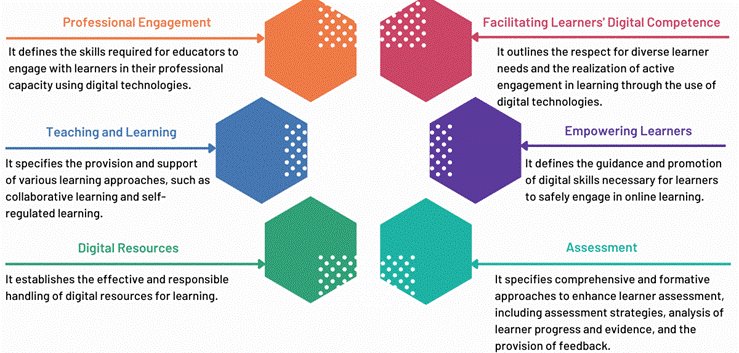
This report focuses on one of the six areas in DigCompEdu: Teaching and Learning. This area highlights the competencies required for educators to improve the quality of instruction through ICT. It is comprised of four key elements: Teaching, Guidance, Collaborative Learning, and Self-regulated Learning. For each of these, we will explore practical examples of how ICT can be effectively applied in classroom settings.
What is “Teaching and Learning” in DigCompEdu?
The Teaching and Learning area in DigCompEdu refers to a framework that emphasizes both the teacher’s role in using digital technologies to deliver instruction (Teaching), and the supportive role of promoting student learning (Learning). This area provides essential perspectives for enhancing the quality of educational practice through ICT and is expected to contribute to the professional growth of educators. Below is an overview of the four key competencies within the Teaching and Learning area:
Teaching
This competency refers to the educator’s ability to use digital technologies to effectively present and convey learning content, thereby improving instructional quality. For example, it involves selecting and integrating videos, slides, and interactive materials in ways that match learners’ levels of understanding and interest.
Keywords: Effective presentation, appropriate selection of materials, tailored communication to learners, improved instructional quality
Guidance
This competency refers to the educator’s ability to use digital tools to understand each learner’s progress and level of understanding, and to provide appropriate support and timely feedback to foster their development. For instance, teachers might use online tools to monitor learning progress and offer personalized advice or encouragement.
Keywords: Individualized support, progress monitoring, appropriate feedback, promoting growth
Collaborative Learning
This competency reflects the educator’s ability to foster interaction and co-construction of knowledge among learners using digital tools. For example, teachers may utilize online collaborative editing tools or discussion forums to create environments where learners can actively engage and contribute together.
Keywords: Interaction, collaboration, co-construction of knowledge, communication, learner engagement
Self-regulated Learning
This competency refers to the educator’s ability to support learners in setting their own learning goals, planning their learning process, monitoring their progress, and engaging in autonomous learning using digital technologies. For example, by using online tools to visualize and track learning objectives and progress, teachers can help learners become more aware of their learning status, make informed decisions about next steps, and take initiative in working toward their goals.
Keywords: Self-management, goal setting, progress monitoring, planning and evaluation, autonomous learning
Thus, the four competencies within the Teaching and Learning area of DigCompEdu offer a structured set of strategies by which educators can enhance learning and instructional quality through the effective use of ICT.
Practical Examples of the Four Competencies in Teaching and Learning
Hearing terms like “teaching ability” or “supporting learning” may sound formal or even overwhelming at first. However, the four competencies outlined in DigCompEdu are actually embedded in many everyday teaching practices. By reflecting on them more consciously, educators can reaffirm the value of what they are already doing and also discover new ideas for enhancing their instruction. In this section, we will explore how each of these competencies can be applied in day-to-day educational settings through concrete examples.
Teaching: Expanding Modes of Instruction through ICT
In this context, Teaching refers to the educator’s ability to enhance lesson delivery and explanations using ICT, allowing for flexible adaptation to students’ levels of understanding.
Challenges in the Field:
Despite the introduction of ICT in classrooms, many teachers express concerns such as: “I have ICT tools, but I’m not using them effectively, or “Even when I use videos or slides, it’s hard to gauge students’ reactions.” While the number of instructional tools has increased, devising effective ways to facilitate understanding remains a challenge.
Examples of Effective Use:
- Customize existing materials into different formats to increase variety in presentation.
- Insert quick quizzes between slides or video segments to check learners’ understanding in real-time.
- Use discussion tools or surveys to provide students with opportunities to express their thoughts and engage in dialogue.
Future Outlook:
The use of ICT opens the door to a shift from one-way delivery to interactive dialogue in the classroom. Rather than simply conveying information, teachers can take on the role of learning navigators—guiding students while staying attuned to their understanding and responses. This approach is expected to foster more learner-centered and responsive teaching practices.
Guidance: Delivering Personalized Support
In this context, Guidance refers to the educator’s ability to use ICT to understand each learner’s level of comprehension and progress, and to provide timely and appropriate feedback and support tailored to individual needs.
Challenges in the Field:
Each learner progresses at a different pace and faces different learning obstacles. This has long been a challenge in traditional group instruction, but the integration of ICT has made learning progress more visible—highlighting these individual differences more clearly than ever. As such, a key challenge now is how to leverage this visible data to offer the right support to each learner at the right time.
Examples of Effective Use:
- Use the auto-grading function of a Learning Management System (LMS) to provide instant feedback, helping learners deepen their understanding on the spot.
- Analyze LMS progress data to offer advanced tasks to learners who are progressing well, while providing supplementary materials to those who are struggling.
- Monitor assignment submissions and comments to grasp each learner’s status efficiently and detect subtle signs of distress before they escalate.
Future Outlook:
Even within whole-class instruction, ICT is creating environments where teachers can offer personalized and targeted support. The teacher’s role is expanding—from being a one-way provider of knowledge to a learning partner who walks alongside each learner. This evolution is expected to bring us closer to a more inclusive educational experience, where no learner is left behind.
Collaborative Learning: Creating Inclusive Spaces for Confident Participation
In this context, Collaborative Learning refers to the educator’s ability to use ICT to support peer-to-peer dialogue and the exchange of ideas, fostering deeper understanding through interaction among learners.
Challenges in the Field:
Although the importance of collaborative learning is widely recognized, it is not always easy to ensure meaningful participation from all students. Common concerns include: “Discussions don’t deepen due to time constraints,” or “Some learners hesitate to speak up, leading to unequal participation.” In particular, students who feel anxious about face-to-face discussion may struggle just to join the conversation. The key challenge is how to lower the barriers to participation and create an environment where everyone can confidently contribute.
Examples of Effective Use:
- Use online tools and shared slides to visually collect and organize students’ input. This helps clarify the flow and key points of a discussion and provides a foundation for deeper dialogue.
- Enable chat functions and online forms to support both asynchronous and non-face-to-face interactions. This reduces the psychological pressure of speaking out and encourages diverse modes of participation.
- Foster a culture of mutual respect by using comment and reaction features (e.g., stamps or likes) to acknowledge others’ ideas, creating a safe and inclusive atmosphere for dialogue.
Future Outlook:
Collaborative learning not only supports the acquisition of knowledge but also nurtures vital 21st-century skills—such as communication, active listening, and flexible thinking. The process of encountering different viewpoints and reconstructing one’s understanding leads to a deeper level of learning that goes beyond simple comprehension. That is why creating a learning environment where all students can confidently engage with one another is crucial for the future of education. Through such inclusive learning spaces, collaborative environments where diverse perspectives are respected and valued can continue to grow and thrive.
Self-Regulated Learning: Cultivating the Ability to Design One’s Own Learning
In this context, Self-Regulated Learning refers to the educator’s ability to support learners in becoming autonomous by using ICT to help them set their own goals, create learning plans, monitor progress, and make adjustments as needed.
Challenges in the Field:
For learners to take ownership of their learning, they must have access to systems that clearly show both their current status and their learning goals—what we might call “learning visibility.” Without a clear sense of where they are and where they’re heading, it becomes difficult to learn in a structured way, and students may end up simply completing assigned tasks without deeper engagement. While ICT tools now make it easier to visualize progress and outcomes, the challenge lies in how to leverage this visibility to foster genuine self-directed learning.
Examples of Effective Use:
- Allow learners to record their learning goals and plans within an LMS so they can proceed at their own pace and reflect on their progress at any time.
- Provide dashboards that display progress and completion rates by topic or unit, helping learners instantly see how far they’ve come.
- Teachers can send reminders or motivational messages when needed to help learners maintain momentum and stay on track.
Future Outlook:
With the support of ICT, the teacher’s role is shifting—from managing and directing every step, to encouraging learners to take responsibility for their own learning. Empowering learners to make informed decisions about their learning process is increasingly recognized as an essential skill—not only in school, but throughout life. Going forward, creating environments that nurture self-regulated learners is expected to become a standard practice in educational settings.
Conclusion
This report has focused on the Teaching and Learning area of the DigCompEdu framework, introducing the specific competencies and support strategies educators need to enhance the quality of instruction through the use of ICT. A key strength of DigCompEdu lies in its emphasis not only on the technical aspect of “how to use ICT,” but also on the educational essence of “how to support learning.”
In recent years, increasing attention has been given to the development of learners’ ability to think independently, express themselves, and take ownership of their learning. As a result, teachers are being called upon to shift their roles—from deliverers of knowledge to facilitators of learning. Now that ICT has been introduced into classrooms, it is more important than ever to re-examine how we engage with learners and to accumulate small, practical improvements in our teaching.
That said, many educators in the field face time constraints and heavy workloads, making it difficult to fully explore the use of ICT. Precisely because of such challenges, frameworks like DigCompEdu can serve as valuable tools—offering a means to reflect on daily practice and grow incrementally, even amid a busy schedule. The Teaching and Learning area in particular organizes ICT usage into four distinct perspectives: how we teach and how we support learning, providing a helpful starting point for educators to reassess their own approaches.
To the frequently asked question in schools—“We have ICT, but how do we use it effectively?”—DigCompEdu offers a strong and supportive response. It is our hope that this framework will continue to be embraced in classrooms as a trusted guide to help educators evolve their practice and empower their learners.
References:
(ⅰ) Promotion of ICT in Education / GIGA School Initiative
https://www.mext.go.jp/a_menu/shotou/zyouhou/index.htm
(ⅱ) Digital Competence Framework for Educators (DigCompEdu)
https://joint-research-centre.ec.europa.eu/digcompedu_en